Hôtel Saint-Gabriel
Interview with the VampireHôtel Saint-Gabriel is the grand Paris residence in which Louis, Claudia, and Madeleine attempt to make an ordered home after their disillusioning search through Eastern Europe. Its immense luxury offers privacy and concealment, but the hotel also becomes the setting for Louis’s encounter with Armand, Claudia’s fear of separation, the vampires’ assault, and the discovery of Claudia and Madeleine’s remains. The hotel therefore changes from sanctuary to trap, then to an empty chamber of grief that Louis cannot inhabit.
Setting and Domestic Transformation
Hôtel Saint-Gabriel stands on the Boulevard des Capucines and is described as one of the largest hotels in Europe. After the bleak journeys through Transylvania, Hungary, Bulgaria, and the Carpathians, Paris itself restores Louis’s sense of animation and possibility. Claudia moves them into one of the hotel’s finest suites, whose immense rooms dwarf the memory of their old town house while also recalling its comfortable splendor. The windows overlook a gas-lit boulevard crowded with strollers and carriages carrying elegantly dressed guests to the Opéra, the Opéra Comique, the ballet, theaters, balls, and receptions at the Tuileries. Claudia chooses the hotel for practical reasons as well as aesthetic ones. The constant movement of European travelers allows the vampires’ nocturnal habits to pass unnoticed; anonymous staff maintain the rooms; and the high price purchases privacy and security. Yet her spending also expresses a personal claim. She calls the hotel her world and insists that she must have it as she likes. She fills it with rose-and-gold wallpaper, damask and velvet furniture, embroidered pillows, silk furnishings, roses, tilted mirrors, and a garden of camellias and ferns at the French windows. Her longing for flowers, absent from the vampire’s life, turns the suite into a cultivated reconstruction of childhood, beauty, and possession. Louis initially accepts this transformation. The hotel’s air recalls the courtyard of their home on Rue Royale, while its profusion of gaslight seems to abolish shadows altogether. Within these rooms, he can momentarily imagine that darkness and vampires do not exist. The suite thus performs a fragile reversal of their condition: an undead household borrows the forms of civilized domestic life and places them under artificial light.
Armand and the Hotel’s Hidden Theatre
The hotel becomes connected to the Théâtre des Vampires when Louis begins visiting Armand. After Claudia warns him that Armand has rendered her powerless and may wish to separate them, Louis leaves her and returns to the theater, convinced that Armand is the only vampire there who can be trusted. Armand’s influence follows Louis back to Hôtel Saint-Gabriel, making the hotel a contested space between the established family formed by Louis, Claudia, and Madeleine and the older vampire’s promise of knowledge and companionship. Louis returns to the hotel near dawn after following Armand through Paris. Madeleine is asleep beside the grate with needle and thread in her hands, while Claudia watches from among the ferns near the window. Claudia immediately understands that Louis has been with Armand and suspects that he wants to leave with him. Their conversation in the suite exposes the emotional division beneath its elegance: Claudia offers to leave Paris with Louis and reminds him that they possess the world, while Louis refuses because he does not want to recreate the arrangement he once had with Lestat. He believes Armand represents something different, although Claudia insists that Louis does not understand what he is choosing. The hotel’s intimacy briefly returns when Louis and Claudia embrace. Their affection remains profound, but it is joined by fear, suspicion, and the recognition that their shared life has become unstable. The suite shelters them from the city while also concentrating the conflict that the city’s theatrical world has introduced. Its flowers, mirrors, velvet, and gaslight cannot prevent the household from becoming politically exposed to the vampires beneath the theater.
The Assault and the Hotel as Trap
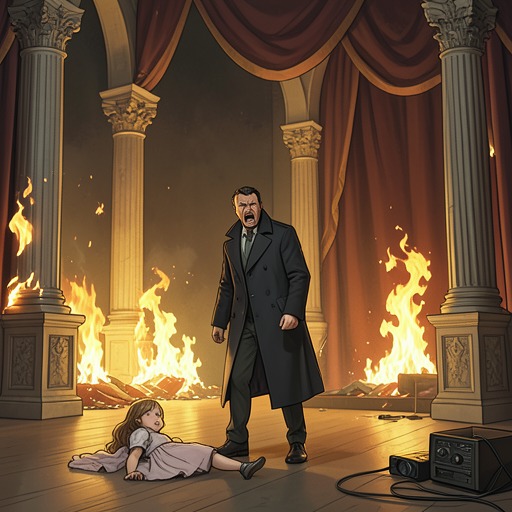
The decisive transformation occurs before dawn, when the vampires of the theater enter the suite. Louis remembers the light gradually being subtracted from the rooms before he recognizes a crowd of black-dressed men and women moving through them. Santiago and Celeste lead the assault, with Estelle and other vampires filling the mirrors and turning the familiar rooms into shifting walls of menace. Madeleine wakes terrified, while Louis tries to force Claudia through the door and hold the entrance against the attackers. The suite’s furnishings become obstacles and witnesses during the struggle. Louis fights Santiago and Celeste, drawing blood from Santiago and sustaining scratches across his face, while Madeleine remains frozen and sobbing amid the surrounding vampires. Louis’s strength is considerable, but numbers and persistence overcome him. He is forced out through the passageways and down the hotel’s back steps, then captured again outside. The rooms that had promised privacy and security are revealed as penetrable; the hotel’s cultivated order has offered no protection against the collective power of the theater. The attackers separate the victims and imprison Louis in a coffin. He hears Madeleine’s cries and fears that Claudia is also being harmed, while his hope rests on Armand’s possible intervention. The coffin is carried away, set down near water and earth, and sealed behind newly laid bricks. In this sequence the hotel’s domestic rooms are replaced by the most compressed possible version of enclosure: a coffin transformed into a tomb. Louis’s memories return obsessively to Claudia in the hotel, making the suite the emotional image against which his confinement is measured.
Death, Remains, and Abandonment
When Louis is brought back to the theater, Lestat reveals that he possesses Claudia’s yellow dress, torn and stained with blood. The garment confirms the violence done to her and becomes a material substitute for the missing child. Louis clutches it while the vampires’ laughter and candlelight recede into an unreal atmosphere. Through an open doorway he then sees the remains of Madeleine and Claudia lying in the rain: Madeleine’s burned body still bears the imprint of her living face, while Claudia has been reduced to ashes. The hotel is subsequently marked by absence rather than occupation. Louis returns to the rooms at Hôtel Saint-Gabriel and places a painting taken from a dying mortal on the mantel above the fire. He sees the familiar flowers, velvet, candles, and furnishings and longs to become mortal, trivial, and safe again. A woman appears there, and Madeleine and Claudia’s presence is felt through the objects and arrangements of the suite, but the household can no longer be restored. Their rooms remain orderly enough to suggest that they might return at any moment, which makes the preserved setting more painful than visible ruin. Louis considers taking belongings belonging to Claudia and Madeleine and preparing graves for them in Montmartre Cemetery, but he abandons the plan. Madeleine’s embroidery ring and bundles of thread lie on a chair-side table, and the task seems meaningless. The hotel therefore functions as an unfinished memorial: its objects retain the gestures of domestic life, but the people who gave those objects meaning are gone.
Departure and Narrative Significance
Louis leaves Paris with Armand soon afterward, traveling toward Egypt rather than Greece and seeking the pyramids, royal tombs, and buried civilizations. Before departing, he goes to the Louvre in an attempt to lay down his soul in art and obliterate his pain. Yet the hotel has altered his relation to beauty. Paintings no longer seem intimately connected to the human hands that made them; they appear severed, preserved, and capable of being reduced to ashes, like Claudia, Madeleine, and Louis himself. Hôtel Saint-Gabriel consequently occupies several layers of the narrative. It is a transatlantic arrival point where the New Orleans vampire household enters the grand modernity of Paris; a carefully managed space of privacy in which Claudia asserts taste, ownership, and control; a threshold linking private life to the public spectacle of the Théâtre des Vampires; and the final interior setting of the family before its destruction. Its luxury does not oppose gothic confinement but disguises it. The suite’s mirrors, flowers, velvet, and artificial light create an aesthetic world that is beautiful precisely because it is precarious, and the hotel’s remembered rooms endure after their inhabitants have become blood, ashes, and irrecoverable memory.